From Five Fragmented Systems to One — Building an AI & Multi-Agent ERP Strategy System

Executive Summary
This case study shares how TecAce Software solved an internal challenge: revenue, cost, and cash flow data scattered across five separate systems — Excel, ERP, SharePoint, and more — made it difficult to get an accurate, real-time picture of the business.
As an AI solutions company, TecAce applied its own technology directly to its own operations. Using Vibe Coding for rapid development and a Multi-Agent architecture where specialized AI agents autonomously handle cash flow analysis, revenue forecasting, and What-if simulations, the team built an integrated ERP & Strategy System in-house. The result: a 60%+ reduction in data entry points and real-time AI-driven business insights.
The Challenge
As TecAce Software grew, so did its toolset. But that variety became a liability. Revenue, cost, and cash flow information was spread across five separate systems, each operating in isolation.
Key Pain Points:
Duplicate Data Entry: Revenue and cost management were split between Excel and a separate ERP, requiring the same data to be manually entered in two places.
No Real-Time Forecasting Integration: The dedicated forecasting system couldn't connect to live cost data or current sales figures, resulting in low accuracy and manual data transfers.
Complex Invoice Workflow: The process required a requester to submit → an issuer to review and issue → manual entry into the revenue system. Each step scattered information further.
No Real-Time Sync: The more entry points there were, the harder it became to keep data in sync. Executives had to manually consolidate information from multiple systems just to understand the current state of the business.
"It was nearly impossible to see accurate information in one place and manage revenue and cash flow at the same time. The systems were operating in silos, and every decision was always one step behind." — Business Executive, TecAce Software
The Solution
A business executive took the lead, working closely with the development team to design and build an ERP & Strategy System for internal use. As an AI solutions company, TecAce applied its own technology directly to solve its own problem.
Phase 1: Unified Data Dashboard (approx. 1 Week)
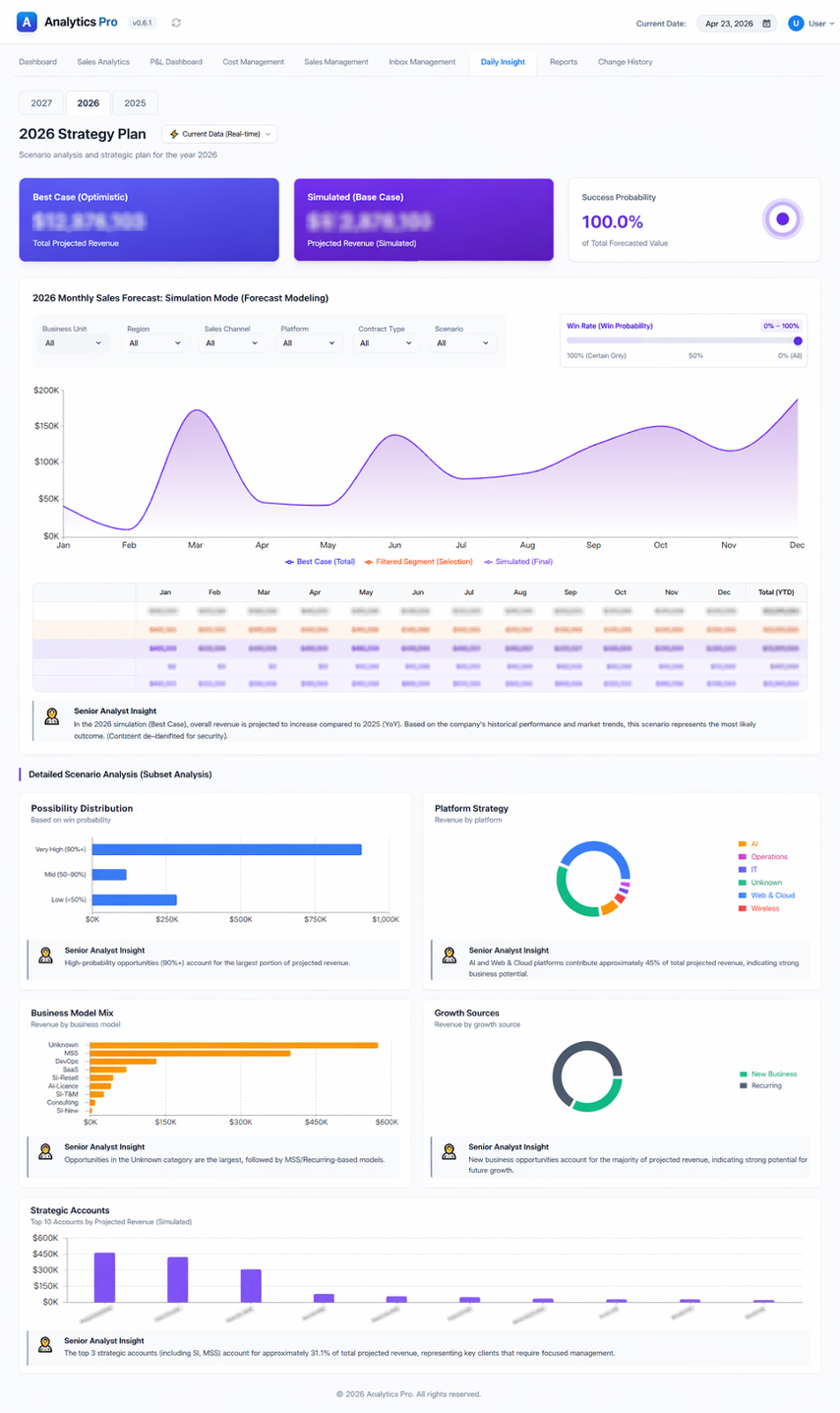
Data scattered across Excel, legacy ERP, and SharePoint was consolidated into a single platform with a real-time dashboard. By connecting each system and redesigning the data input flow, duplicate entries were eliminated. Thanks to Vibe Coding's rapid iteration approach, the initial build was completed in roughly one week, with low migration cost since existing data was used as-is.
Phase 2: Multi-Agent AI Analysis & Insights Engine
Going beyond data integration, TecAce built a Multi-Agent system where specialized AI agents collaborate to perform analysis, forecasting, and simulation autonomously.
What is a Multi-Agent Architecture? Rather than a single large AI model handling everything, specialized agents work in parallel — each an expert in its domain. An Orchestrator analyzes the user's request, delegates tasks to the right agents, and consolidates their outputs into a final, actionable insight.
The specialized agents built into the system:
Cash Flow Agent: Monitors inflows and outflows in real time, automatically detecting risk periods and triggering alerts.
Forecast Agent: Generates revenue predictions from pipeline data and detects year-over-year anomalies.
Simulation Agent: Instantly simulates the financial impact of variable changes — no Python coding required.
Insight Agent: Interprets data patterns and generates strategic insights for new business opportunities and investment decisions.
Orchestrator: Parses user requests, routes tasks to the appropriate agents, and returns consolidated results.
How agents collaborate — an example: When an executive asks, "What happens to our cash flow if next month's revenue drops by 10%?" — the Orchestrator simultaneously calls the Simulation Agent and the Cash Flow Agent. Both run their analyses in parallel, and the Insight Agent consolidates the results into a clear, decision-ready summary on a single screen. What used to take hours of Python scripting and manual data gathering now completes in seconds.
The Results
After introducing the new system, the way the team works has fundamentally changed.
Operational Efficiency
60%+ reduction in data entry points — saving time while simultaneously reducing input errors.
Invoice processing is now handled automatically within the system, eliminating separate communications and manual entries.
Improved data consistency — the old model of entering data into multiple systems has been replaced by single-entry → automatic sync.
Decision-Making Speed & Quality
Business executives can now view revenue, costs, and cash flow status in real time on a single screen.
The Multi-Agent system processes complex, multi-dimensional analysis requests in parallel — scenarios that once took hours now complete in seconds.
Simulation Agent and Cash Flow Agent collaboration enables instant What-if scenario review, with no Python coding required.
Strategic Value
The Insight Agent continuously analyzes data patterns, providing concrete, data-backed inputs for new business opportunity identification and investment prioritization.
With AI proactively detecting anomalies and issuing alerts, executives can act ahead of problems rather than discovering them after the fact.
A more transparent view of the future has made it easier to align the entire organization around a shared direction.
This system has grown beyond a simple data integration tool — it now serves as a powerful business intelligence platform where AI agents act as partners in decision-making.

Next Steps
TecAce Software plans to continue evolving the system with the following enhancements:
Improved AI prediction accuracy: Training on more internal data to sharpen the Forecast Agent's models.
Role-based dashboard views: Tailored experiences for executives, sales, and finance teams.
External data integration: Incorporating market data, exchange rates, and other variables into the Simulation Agent engine.
Mobile accessibility: Enabling instant access to key KPIs and AI alerts on the go.
Considering an AI-powered business solution? Start the conversation with TecAce today.




Comments