How TecAce FDEs Automate DevOps with AI

In the previous article we explained what an FDE (Forward Deployed Engineer) is and how one works in the field.This article is a record of applying that approach inside a development and operations organization. In work that repeats every day — the deployment pipeline, incident response — it covers which segments AI should go into and which should be left to people.
AT A GLANCE | DETAILS |
Who this is for | Leaders of development and operations organizations facing a growing deployment cadence and incident-response load |
The problem | Code is produced faster, but review, testing and deployment cannot absorb that pace |
Core methodology | Lead-time measurement → assignment of handlers by segment → setting the level of autonomy → designing the permission path → verification against the baseline |
Evidence base | The DORA report, published implementations from Meta, Uber, BT Group and Microsoft, and industry survey metrics |

The first question raised when a development organization considers adopting AI is which tool to use. What is observed in the field, however, is usually not an absence of tools but a stalled flow. Code is already being written quickly, and the review, testing and deployment approval behind it cannot match that pace.
TecAce FDE therefore starts not with tool selection but with lead-time measurement. We divide the path a single change takes from authoring to production into segments and measure the time in each, separating the segments where people wait from the segments where the same work is repeated.
What to automate is decided by the measurements
In the Audit stage we read repository APIs, CI job logs and incident tickets exactly as they are and calculate the time spent in each segment. There is no need to organize materials for us. Raw records show the real bottleneck more accurately.

The measurements tend to come out in a similar shape. Actual work time accounts for a small share of total lead time, and most of it goes into waiting for review, re-running tests, and waiting for deployment approval. A large share of failed tests are handled by re-running them without identifying the cause, and the first part of incident-response time goes into gathering material rather than finding the cause.
The deliverable of this stage is not a list of improvement tasks but a baseline. Only by recording segment times and rework rates as numbers can we later judge, on the same basis, whether a change actually had an effect.
We divide the handler for each segment
What the Eval stage decides is not whether to use AI but where to place it. Handing the entire pipeline to a model increases cost and errors together. Segments with clear criteria are more accurate and cheaper to handle with rules, and the result is always the same.

Taking review as an example, we compose the processing order like this. Static analysis filters out format and rule violations first, the model summarizes the intent and blast radius of the change, and the risk level is flagged on the basis of change size and affected domain before the change is routed to the right reviewer. The approval itself is made by the reviewer. Keeping this order reduces review wait time while leaving the accountability structure intact.
For tests, selection matters more than generation. A generated test is adopted only when it passes all four conditions — the build succeeds, repeated runs give the same result, coverage increases, and it does not duplicate an existing test. Increasing the volume generated without conditions accumulates unstable tests and lowers trust in the pipeline instead.
We design the level of autonomy and the permission path together
In the Deploy stage, alongside the build, we decide how far to process automatically. We automate reversible actions first, and actions that are hard to reverse are raised only as approval requests.

Early on it is safer to apply only automatic rollback and cause diagnosis. Fix generation is raised only as a review request, and whether to apply it is judged by the person responsible. Once improvement against the baseline is confirmed and false positives fall to a manageable level, we widen the scope of the target work.

Once agents begin to access the pipeline and the infrastructure, permission design becomes the safety mechanism. We fix the three classifications — allowed, approval required, blocked — at kickoff and provide an interface that can call only what is within the allowed scope. Control rules work in practice only when they are implemented in the platform rather than in a document.
The purpose of automation is not to reduce headcount
Once the segments are divided, a question naturally follows: what, then, do people do? The answer is clear. Judgment. When people take their hands off collecting, matching and formatting, that time goes into deciding how to handle exceptions, how much risk to accept, and whether it is safe to deploy now.

What matters is that this relationship does not end after one pass. A judgment a person makes is not consumed on the spot but recorded as thresholds, exception rules and checklists. The recorded standards become the scope AI can handle in the next cycle. Items a person checked every time at first move into automatic verification once the standard is set.
This approach therefore grows more effective over time. The case where the cycle breaks is equally clear. If a judgment is made but the rationale is left nowhere, a person judges the same problem again the following quarter. What widens the automation scope is not model performance but the volume of standards accumulated in the organization.
DevOps automation with AI is already proven at many companies and is spreading rapidly
This approach is not one company's experiment. Looking at published cases, the points of application almost entirely overlap: code review, test augmentation, alert handling and incident triage, and triage of security scan results.
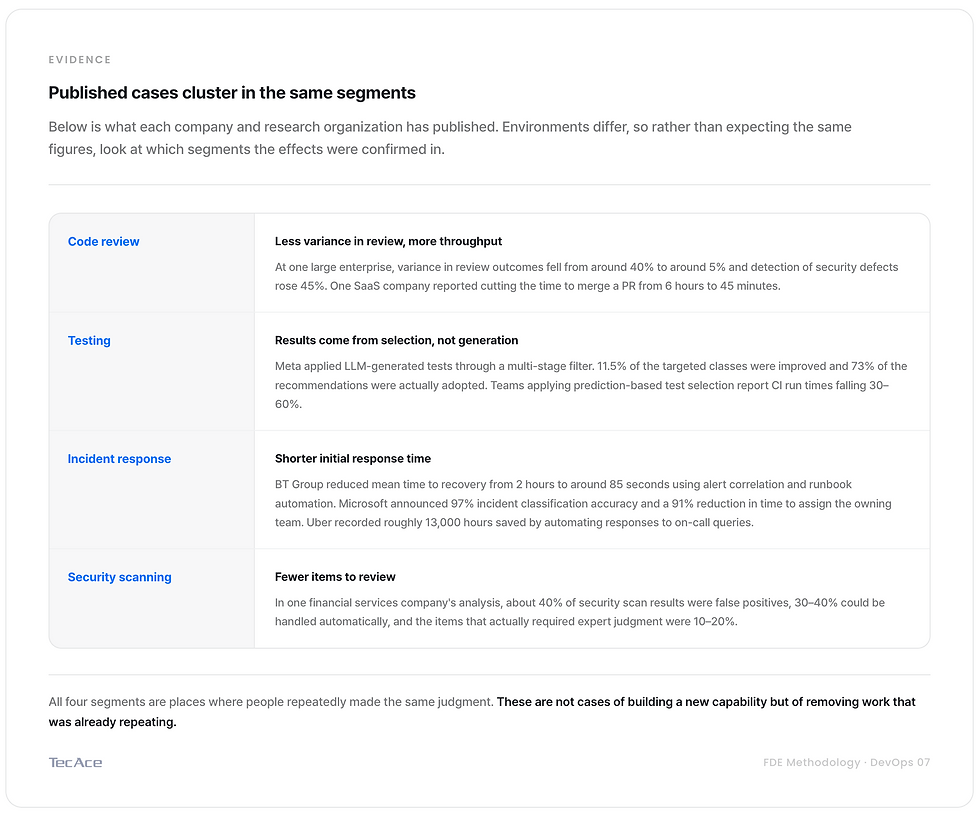
To borrow the DORA report's phrasing, AI does not change an organization; it amplifies the state that was already there. In an organization whose flow is in order the effect of adoption appears quickly, and in an organization where a bottleneck remains that bottleneck becomes more pronounced. This is why the flow should be measured before tools are added.
TecAce FDE carries out this process inside the development organization. Leaving the existing repository and CI tools in place, we automate the segment with the highest wait ratio first, measure again the same way as the baseline taken at diagnosis to confirm the change, and then widen the scope.
Frequently Asked Questions (FAQ)
Q. Do we have to replace our existing pipeline?
No. We leave the repository, CI tools and ticket system you currently use in place and add the processing needed in the segments identified by measurement. A plan that presumes replacing tools delays adoption itself.
Q. How can we trust code that AI produced?
Trust rests on the pass criteria, not on the model. Generated output has to pass the same existing tests and static analysis, and in the case of tests only those meeting all four conditions — build success, passing on repeated runs, increased coverage, removal of duplication — are adopted.
Q. Is it safe to give agents operational permissions?
We do not hand over credentials as they are. The three classifications — allowed, approval required, blocked — are fixed at kickoff, and we provide an interface that can call only what is within the allowed scope. Every execution is recorded under an identifier distinct from a person's.
Q. Which metrics confirm the effect?
We re-measure the same way as the baseline taken at diagnosis. We compare total lead time, wait-time ratio, rework rate, change failure rate and mean time to recovery; tool adoption rate is not used as a performance metric.
Q. Can this be applied to a small development organization?
Yes. The fewer people there are, the more review waiting acts as the bottleneck. Rather than changing everything at once, we apply it to the single segment with the highest wait ratio and then widen the scope.



Comments