From 12,000 Scattered Documents to a Living Knowledge Graph — Building AXKH on Ontology-Based RAG


Conceptual Case Study. This case study is a representative scenario built to illustrate how TecAce's AXKH (AX Knowledge Hub) solution addresses the challenges typically faced by our target customer profile — mid-sized global manufacturing and distribution companies. Actual results will vary depending on industry, scale, and data environment.
Executive Summary
A global manufacturing group, "G Group," headquartered in the US with sales and service hubs across Asia and Europe, owned more than 12,000 documents, meeting notes, and case records spread across departments — yet could not reliably answer the question, "Who decided what, and why?" TecAce designed and deployed AXKH (AX Knowledge Hub), combining our proprietary Ontology-based RAG engine, a Multi-Agent knowledge pipeline, Human-in-the-Loop governance, and our AI Supervision solution.
Within six months, scattered documents were restructured into 8,500+ nodes and 23,000+ relationships, proposal lead times dropped by 65%, new-hire onboarding time was cut by 50%, AI responses achieved 100% source traceability, and hallucination rates were held below 1.2%.

The Challenge
G Group is a manufacturing company generating roughly USD 450M in annual revenue, with its headquarters in the US and sales and service operations in three additional countries across Asia and Europe. Five geographic hubs were serving the same customers, but information flowed in fragmented silos — divided by location, department, and toolset.
Core problems
Fragmented documentation — Meeting notes lived in Teams, proposals in SharePoint, customer service cases in Zendesk, policy documents in Notion, and technical reference material in Confluence. Five repositories held overlapping information about the same topic, and no one knew where to start.
Lost context — Questions like "Why was this decision made?" or "What policy does this case rely on?" could not be answered quickly. The documents existed, but the relationships between them lived nowhere.
Information asymmetry across hubs — A quality issue resolved in the US hub never reached the European hub, and the same problem reappeared six months later.
Mismatched information needs by role — Executives need a one-page summary. Practitioners need the source document and the surrounding reasoning. Showing both groups the same file fails everyone.
The trust barrier for AI adoption — Off-the-shelf enterprise chatbots and generic RAG systems produced answers with no clear source, no awareness of data freshness, and no protection against exposing sensitive information.
"We were not a company short on information. We were drowning in it. The problem was that none of it was connected, and so none of it was usable." — Chief Strategy Officer, G Group
The Solution
TecAce designed AXKH not as a search engine or chatbot, but as an operating layer where knowledge is collected, understood, connected, used, and continuously re-learned. The guiding principle: "Don't store documents — store relationships."
Phase 1 · Knowledge Pipeline Foundation (4 weeks)
We first built secure connectors to the five source systems (Teams, SharePoint, Zendesk, Notion, Confluence). At this stage, all documents are indexed in read-only mode without modifying the originals, and PII and confidential information are routed through a dedicated masking pipeline before any AI processing.
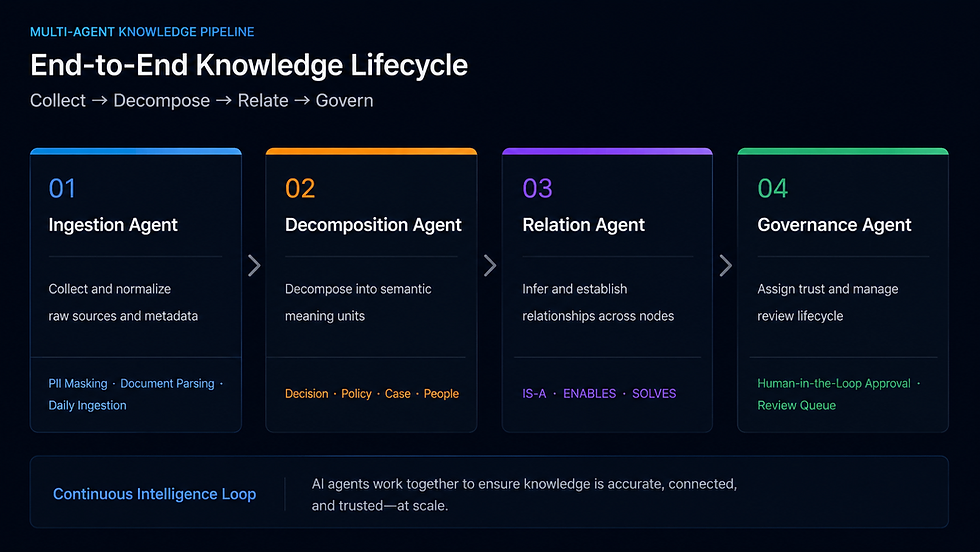
Ingested documents are never stored as-is. Instead, a Multi-Agent architecture runs them through four specialized agents, working sequentially and in parallel.
Ingestion Agent — Extracts text, tables, and images from source documents and attaches metadata (author, date, origin).
Decomposition Agent — Breaks long documents into meaning-level nodes — not generic chunks, but concept-level units such as decisions, rationales, cases, policies, people, and projects.
Relation Agent — Infers the relationships between nodes and encodes them as semantic edges (IS-A, ENABLES, SOLVES, USED-IN, RELATED).
Governance Agent — Assigns confidence tiers (EXTRACTED / INFERRED / SUGGESTED) to each generated node and edge, and automatically routes items requiring human judgment into the Review Queue.
Phase 2 · Ontology-Based RAG Engine (6 weeks)
Ontology-Based RAG: Traditional RAG retrieves "document chunks most similar in vector space." Ontology-Based RAG adds graph-level reasoning on top of vector retrieval. When a user asks "What grounds this decision?", the system doesn't just return similar paragraphs — it traverses the graph from decision node → grounding policy node → related case nodes, and re-composes the answer along that path.

Phase 3 · Human-in-the-Loop Governance (3 weeks)
AXKH's most important design decision was the principle that "AI proposes, humans approve."
Review Queue — Newly generated nodes and edges do not enter the live graph automatically. They land in a Draft state in the Review Queue, where domain owners can Approve, Edit, or Reject each item before it becomes part of the canonical knowledge.
Lineage tracking — Every node carries a full provenance record — who created it, when, from which source, using which AI model.
Confidence tiering — When multiple independent sources agree on the same fact, confidence rises. When only a single source exists or the relationship is inferred rather than extracted, confidence is flagged lower.
Phase 4 · Role-Adaptive Output and AI Supervision (4 weeks)
The same data does not serve executives, practitioners, operators, and sales the same way. AXKH re-composes the same underlying knowledge into different formats depending on who is asking.
Executive view — One-page summary, key indicators, and decision options.
Practitioner view — Direct source quotes, links to original documents, and related cases.
Sales view — Customer persona, related success stories, and proposal templates.
Finally, we integrated TecAce's AI Supervision solution to continuously detect and correct hallucinations, bias, and information staleness in production. Every response is checked in real time for source consistency, confidence, information freshness, and sensitive-data exposure.

The Results
Measurements taken six months after deployment.
Knowledge as a Quantified Asset
8,500+ nodes and 23,000+ relationships — More than 12,000 source documents fragmented across five systems were restructured into a single semantic graph of nodes and edges.
~120 new draft nodes per week, automatically generated — TecAce's Daily Research Pipeline ingests external industry news, papers, and competitor signals every morning and produces draft nodes for human review.
87% governance pass rate — 87% of AI-generated drafts cleared human review and were promoted into the live graph.
Decision-Making Speed
65% reduction in proposal and RFP lead time — Proposal drafts that previously took five business days now take an average of 1.7 business days, thanks to graph-driven retrieval of related cases, policies, and prior decisions.
50% reduction in new-hire onboarding — New employees who previously needed eight weeks to internalize the company's decision context and case history now reach the same level in four weeks.
4× increase in cross-hub case reuse — Cases resolved in the US hub are now searched, reused, and adapted by the European hub four times more often than before deployment.
AI Answer Accuracy and Trust
100% source-traceable responses — Every AXKH response is delivered together with the underlying nodes and the graph path traversed to compose it.
Hallucination rate below 1.2% — AI Supervision's real-time verification layer automatically blocks responses that fail consistency checks against their cited sources.
Executive trust score: 91/100 — The internal trust score for AI tools among executives was 42 before deployment.
AXKH became more than a search engine or chatbot — it became a knowledge operating platform that structures and reactivates a company's collective memory. Documents are no longer dead artifacts sitting somewhere in storage. They become a living asset, connected to one another and producing meaning together.
Next Steps
AXKH is the flagship solution under the Knowledge / RAG Pillar of TecAce's AX Consulting Framework. Planned expansion includes:
Agent Pillar integration — Autonomous business agents that draft reports, proposals, and customer responses directly on top of the knowledge graph.
On-device knowledge extension — Combining AXKH with mobile On-device LLMs so that sales teams in the field or operations in air-gapped environments can still access the core knowledge graph without external connectivity.
AX Score integration — Linking each customer's AX Position Score and AX Readiness Score to live nodes in the graph, so that consulting outputs translate directly into executable decisions.
Turn your scattered knowledge into a connected asset. Start the conversation with TecAce today.


Comments