Beyond the One-Size-Fits-All Summary — Building a Personalized AI Meeting Note System

Executive Summary
AI-powered meeting summaries are nothing new. TecAce Software had already been using various solutions to boost productivity through automated meeting recaps. But two persistent pain points remained: every attendee received the same summary regardless of their role, and recurring meetings lacked the continuity needed to surface meaningful insights. To solve this, the team built an internal Personalized AI Meeting Note System — integrating Speaker Recognition, Ontology-based relationship mapping, and Project Folder context to transform meeting notes from passive records into active decision-support tools.
The Challenge
Summarizing a meeting with AI is no longer the hard part. The real challenge is making those summaries actually useful for the right people, in the right context.
Key Pain Points:
One summary for everyone: The person giving the report and the person receiving it need fundamentally different takeaways. Executives need high-level decisions; practitioners need their specific action items. Sending identical summaries to both is inefficient — and often ignored.
Context-free summaries: In recurring meetings or project-based discussion threads, a summary that stands alone loses the thread. Without historical context, there's no way to track progress, spot patterns, or draw meaningful insights.
No speaker differentiation: Before any of this could be fixed, a foundational problem had to be solved first — knowing who said what. Distinguishing and identifying individual speakers in a recording was the prerequisite for everything else.
The Solution
Three technical challenges were tackled in sequence to build the full system.
Phase 1: Speaker Diarization — Prompt Engineering
The first step was separating speakers within a recording. By combining Gemini 1.5 Flash with carefully crafted prompt engineering, the team achieved reliable speaker diarization at remarkably low cost. The model's pricing made it accessible for high-volume use, while targeted prompting ensured accurate speaker separation across the majority of meeting scenarios.
Phase 2: Speaker Identification — Voicetag Integration
Diarization tells you that there are different speakers. Identification tells you who they are. Using the open-source Voicetag library, individual users' voices were enrolled into a database and matched against incoming recordings. This is compute-intensive work, but it laid the foundation for truly personalized, person-specific meeting notes.
Phase 3: Relationship Mapping — Ontology-Based Structure
To understand the dynamics between participants, the team applied an Ontology-based modeling approach to define relationships — roles, reporting lines, seniority, and project involvement. With this structure in place, the AI doesn't just record what was said — it understands who said it and why it matters in context, enabling nuanced, role-aware summaries.
Phase 4: Project Folders and Context-Aware AI Chat
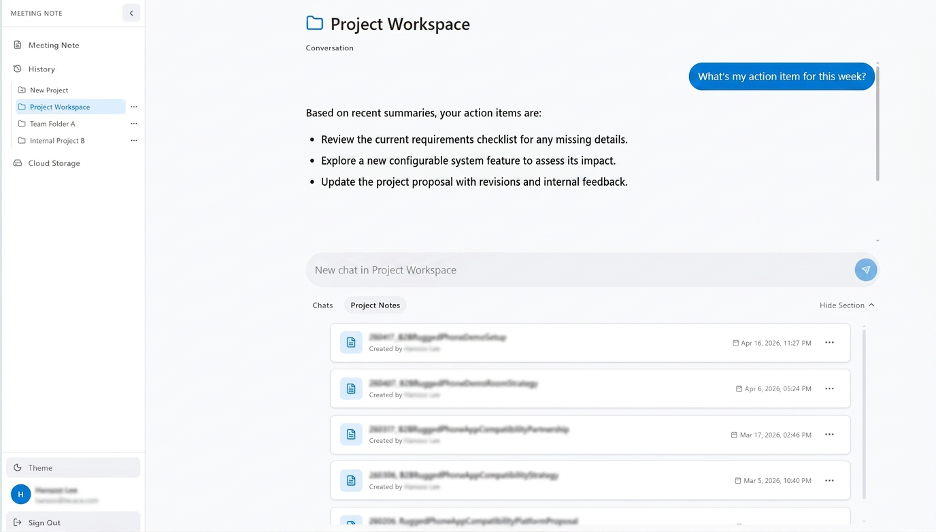
Related meetings are grouped into Project Folders, creating a persistent knowledge base for each initiative. Within a folder, users can chat with an AI that has full context of all past meetings in that project — enabling fast retrieval of historical discussions and generating new insights grounded in the actual meeting history.
The Results
Personalized Meeting Notes
The same meeting now produces different summaries for different people. Executives receive a decision-focused recap; practitioners get a summary built around their own Action Plans.
Because the AI understands the nuance and context of each person's role, the "what do I need to do next?" is no longer buried in a wall of text — it's front and center for each recipient.
Project Folder AI Chat
Searching across an entire project's meeting history is now instant. The hours spent hunting through old notes or asking "what did we decide last time?" are gone.
History-grounded AI chat makes it possible to generate new ideas, revisit past decisions, and surface insights that would have been invisible across fragmented individual summaries.
Recurring meetings now have continuity — each session builds on the last, turning isolated events into a coherent, evolving conversation.
What started as an effort to improve meeting summaries has become a team knowledge management platform — one that structures collective memory and puts it to work through AI.

Next Steps
Speaker recognition accuracy: Expanding the voice database and refining the matching pipeline to improve speed and precision.
Real-time processing: Optimizing the pipeline so personalized summaries are delivered the moment a meeting ends.
Workflow tool integration: Connecting with calendars, Slack, and email so Action Plans flow automatically into the tools people already use.
Multilingual meeting support: Extending accurate speaker recognition and personalized summaries to meetings where Korean and English are used interchangeably.
Interested in AI-powered meeting productivity for your team? Start the conversation with TecAce today.



Comments